
Ask any York Surveyors team member which property type they survey most often in York, and the answer is always the same: Victorian terraced houses. From Fishergate to Holgate, from Bishopthorpe Road to Tang Hall, the city's Victorian stock is vast, popular and — from a surveyor's perspective — wonderfully consistent in the types of defects it presents.
In this article, Rachel Whitmore MRICS — our senior residential surveyor — shares the ten defects she encounters on almost every Victorian terrace survey she carries out in York. Consider this your inside view of what your own survey is likely to find.
1. Missing or Failed Damp-Proof Course
This is the single most common finding in York's Victorian terraces. Properties built before approximately 1875 were frequently constructed without any damp-proof course whatsoever. Where DPCs were included, they were typically slate or engineering brick at low level — materials that can fracture, bridge or fail over time.
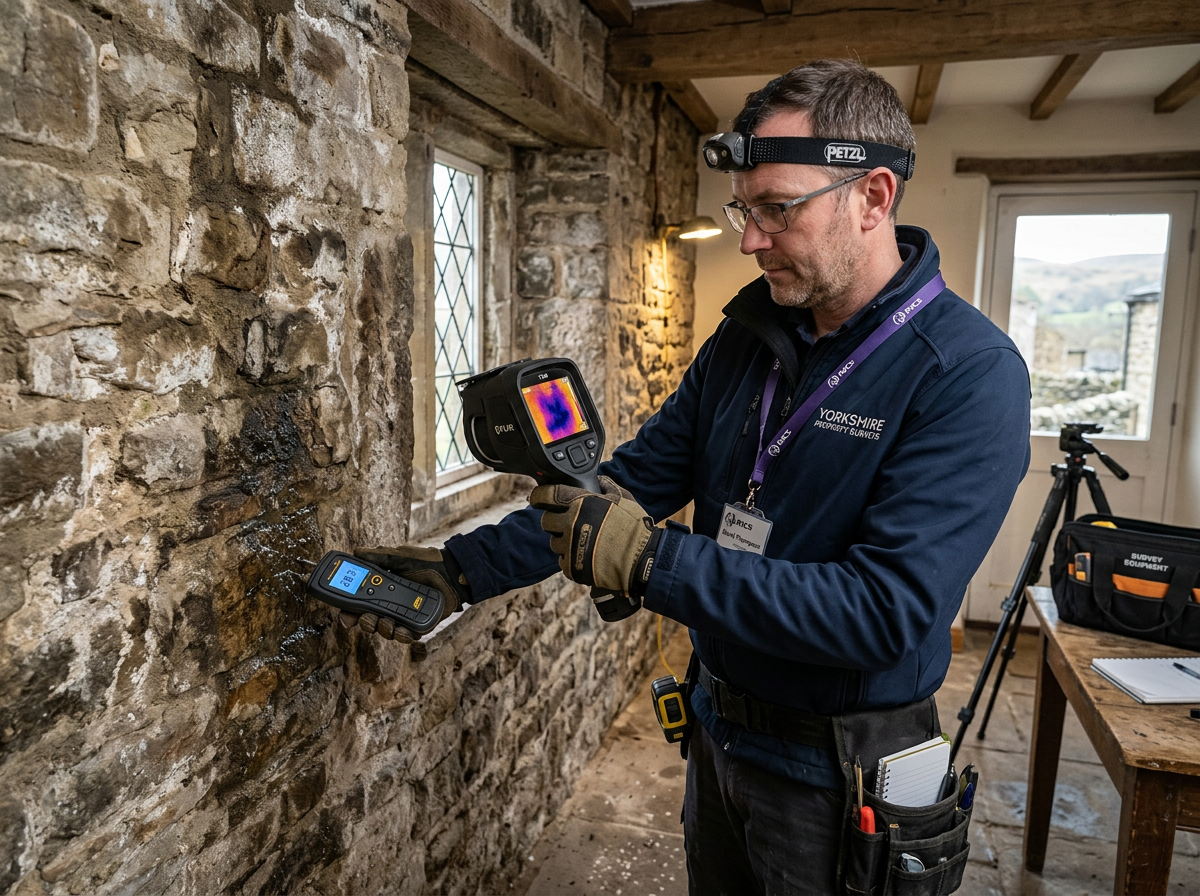
Signs of rising damp include tide marks on lower walls (usually up to about 1 metre), efflorescence (white salt deposits), flaking paint or plaster, and a distinctive musty odour. We use calibrated Protimeter moisture meters to take readings at multiple heights and locations, producing a moisture profile that distinguishes true rising damp from condensation or penetrating damp.
Thermal Imaging Included as Standard
All York Surveyors Level 2 and Level 3 surveys include thermal imaging camera readings. This allows us to detect hidden moisture — including damp concealed behind freshly applied plaster — that is invisible to the naked eye.
2. Defective Chimney Stacks
A standard York Victorian terrace typically has one or two chimney stacks serving two or more flues. These stacks are exposed on all sides to York's often damp and occasionally harsh weather. On virtually every Victorian terrace we survey, we find at least one of the following:
- Failed mortar pointing on chimney stack brickwork
- Cracked or broken chimney pots
- Defective flaunching (the mortar cap at the base of pots)
- Failed lead flashings at the junction between stack and roof slope
- Chimney stacks that are leaning or have moved
Chimney defects are worth taking seriously. A leaking stack can allow water ingress into the roof space and down into the chimney breast within the property. Repointing a chimney stack typically costs £800–£2,000 depending on height and access. A structural chimney repair or rebuild can cost considerably more.
3. Roof Slate Defects
Most York Victorian terraces were originally roofed in Welsh slate — a premium material that, when in good condition, can last a century or more. However, the vast majority of properties we survey have had partial or complete roof works at some point in their history, and the quality varies enormously.
We commonly find a patchwork of different slate types (Welsh, Spanish, Chinese and synthetic), poorly aligned slates, missing torching (the mortar pointing on the underside of slates in older roofs), and deteriorating ridge tile bedding. The presence of a "rubber" (butyl or felt) membrane in the roof space is often a sign that an earlier roof covering has failed and been overlaid rather than replaced.
4. Cast-Iron Gutters and Rainwater Goods
Original Victorian properties used cast-iron rainwater goods — gutters, downpipes and hoppers. Cast iron is durable but requires regular painting to prevent corrosion. When joints between sections fail — and they frequently do — rainwater spills against the external wall face, saturating the masonry and causing persistent penetrating damp on internal surfaces.
On almost every survey of an unrenovated Victorian terrace, we identify at least one section of failed gutter joint or cracked downpipe. Replacement with modern UPVC or powder-coated aluminium is a common and cost-effective repair.
5. Sub-Floor Damp and Timber Decay
Ground floor rooms in Victorian terraces typically have suspended timber floors — floorboards spanning joists, with a void beneath. For this system to function correctly, sub-floor ventilation must be maintained through airbricks in the external walls. We frequently find airbricks that are blocked, bridged by raised external ground levels, or simply absent.
The result is a poorly ventilated sub-floor void with elevated humidity — ideal conditions for wet rot, dry rot and woodworm (furniture beetle) infestation. Remediation ranges from clearing blocked airbricks (a DIY job) to complete replacement of decayed floor joists (potentially £5,000–£15,000).
6. Altered Internal Layout Without Building Control
York's Victorian terraces are frequently modified over the decades — chimney breasts removed, walls opened up, rear extensions added. Very often, these works were carried out without Building Regulations approval or Local Authority consent. We regularly flag:
- Chimney breasts removed at ground floor with the upper breast still supported on the party wall — a structural concern
- Structural walls removed with inadequate or absent supporting beams
- Extensions built without Party Wall notices or appropriate building control sign-off
Where works appear to have been carried out without appropriate consents, we recommend that your solicitor raise requisitions with the vendor and seek indemnity insurance or retrospective consent as appropriate.
7. Lime Plaster Condition
Original Victorian interiors used lime plaster on lath — a flexible, breathable system that can last indefinitely when properly maintained. However, lime plaster is susceptible to failure where it has been in contact with moisture, where vibration has loosened the keys, or where it has been overpainted with modern impervious paint. Areas of hollow, detached or cracked plaster are extremely common findings — and can be expensive to reinstate properly in listed buildings or conservation areas where like-for-like repair is required.
8. Old Electrical Wiring
Many York Victorian terraces retain old electrical systems — round-pin sockets, rubber-insulated cabling, ceramic fuse boards — that do not meet current Part P Building Regulations. While not in itself dangerous if maintained, old wiring systems require inspection by a qualified electrician and should be budgeted for renewal. Full rewiring of a three-bedroom terrace typically costs £3,500–£6,000.
9. Structural Cracking at Bay Windows
Bay windows — a defining architectural feature of York's Victorian terraces — sit on their own foundations and are prone to differential movement relative to the main structure. We consistently see stepped or diagonal cracking at the junction between the bay and the main front elevation. Most such movement is historic and stable, but we assess each case carefully and recommend monitoring or specialist investigation where active movement is suspected.
10. Rear Extensions in Poor Condition
Many Victorian terraces have had rear single-storey additions — often original outriggers that have been extended or modified over time. These frequently present a combination of issues: flat roofs at or beyond end of life, poor junction details with the main structure, inadequate weatherproofing and condensation issues if not thermally upgraded. Flat roof replacement typically costs £1,500–£4,000 depending on size.
Which Survey Should You Book for a York Victorian Terrace?
Given the range and predictability of defects described above, we strongly recommend a Level 3 Full Building Survey for any Victorian terrace in York. This provides:
- Full inspection of roof space, sub-floor void and all accessible areas
- Detailed defect descriptions with repair cost guidance
- Thermal imaging and damp meter readings as standard
- Plain-English findings with traffic-light condition ratings
- Free 30-minute post-survey consultation with your surveyor
Level 3 surveys for two to three-bedroom Victorian terraces in York start from £500. Contact us for a fixed-price quote within two hours.
No — Victorian terraces are consistently popular in York and rarely struggle to sell when priced correctly. Buyers appreciate their character, proportions and central locations. Keeping on top of key maintenance items (roof, gutters, repointing) ensures your property remains in strong condition for resale.
A full renovation of a three-bedroom York Victorian terrace — including new kitchen, bathroom, rewire, replumb, new windows, roof repairs and redecoration — typically costs between £60,000 and £120,000 depending on specification. Our Level 3 survey report will identify which items are essential repairs and which are improvements, helping you prioritise spending.
Most internal works do not require planning permission. External changes — extensions, new windows, roof alterations — may require consent, particularly if the property is in one of York's many conservation areas. If the property is listed, Listed Building Consent is required for most alterations. Our survey report will flag any relevant planning or heritage constraints.
Book Your Victorian Terrace Survey Today
York Surveyors carries out more Level 3 surveys of Victorian terraced houses in York than any other surveying firm in the city. Our reports are comprehensive, photographic, plain-English and always backed by a free post-survey consultation.
Request your free quote online today.

Rachel has carried out hundreds of Level 3 surveys on York Victorian terraces. Her reports are renowned for their clarity, depth and practical repair guidance.